
Angela Biddlestone
Founder of The Next Rep
She looks like a completely different player during games. Sound familiar?
At practice, she's making solid contact, fielding everything hit her way, and executing the skills you've spent weeks developing.
Then game day comes.
Get the free workbook
Free download: The Next Rep Workbook
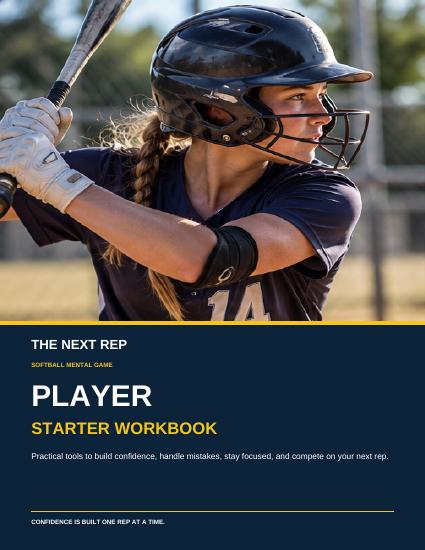
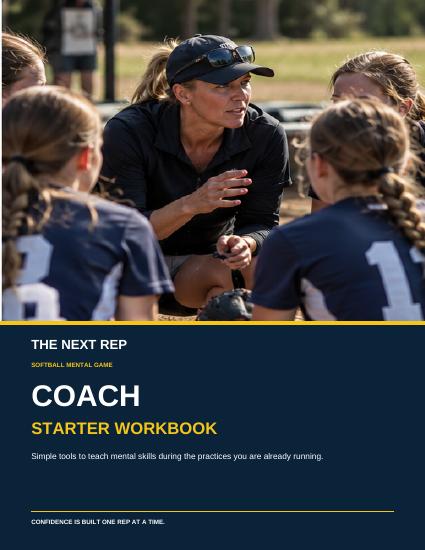
Get the free workbook made for you: player, parent, or coach.

She's hesitant. She's overthinking. Her timing is off. Maybe she makes one mistake, and suddenly everything seems to unravel.
As coaches, we've all seen some version of this.
And it's frustrating because we know what the player is capable of.
But here's where I think we sometimes get it wrong.
We assume she just needs more confidence, needs to relax, or needs to get mentally tougher.
What if the problem isn't that simple?
Having spent years playing and coaching softball, including at the NCAA Division II level and in travel ball, I've learned that there's a difference between being able to execute a skill in practice and being able to apply that skill during competition.
And that difference is something we can help players work through.
First, Find Out What's Actually Changing
Before making another mechanical adjustment or telling a player to stop thinking so much, I'd start with a conversation.
Ask her:
- What feels different when you're playing in a game?
- What are you thinking about before your at-bat or when the ball is hit to you?
- Are you worried about making a mistake?
- Do you feel like you have to get a hit or make every play perfectly?
- What feels easier during practice?
Then listen.
Sometimes players are so worried about disappointing their coach, teammates, or parents that they become hesitant.
Sometimes they're thinking about mechanics instead of reacting to the game.
Sometimes they're focused on the outcome rather than what they need to do next.
And sometimes they're simply struggling with the speed, unpredictability, or quality of competition.
We can't coach the problem effectively until we understand what might be causing it.
1. Make Practice Look More Like the Game
This is one of the biggest opportunities I see in youth softball.
We spend a lot of time practicing skills in controlled environments.
And there's absolutely a place for that.
Tee work, front toss, repetitive fielding drills, and mechanical instruction are all valuable.
But games aren't controlled environments.
Players have to recognize situations, make decisions, respond to pressure, and adjust when things don't go according to plan.
So why not give them more opportunities to practice those things?
Try This: The Game-Day Hitting Challenge
During an existing hitting station, turn a few rounds into game-like at-bats.
Give the hitter a situation:
Round 1: Runner on second, no outs.
Round 2: Two strikes, runner on third.
Round 3: Tie game, two outs.
Before each round, ask:
"What's your approach?"
Then let her hit.
Afterward, ask:
"Did you commit to your plan?"
"What did you recognize?"
"What would you adjust?"
Don't judge the entire activity by whether she got a hit.
Look at her decisions, pitch selection, quality of contact, and ability to make adjustments.
You're still developing her hitting skills.
But now you're also developing the mental skills she'll need during games.
Coaching note: Use live or varied pitching when appropriate. A tee can help reinforce an approach, but it can't fully recreate pitch recognition, timing, or the decisions required in a game.
2. Teach Players a Routine They Can Trust
One of the biggest differences between practice and games is how much attention players give to the outcome.
During practice, a hitter might take 30 swings without thinking much about the result.
During a game, every swing suddenly feels important.
She's thinking about her batting average, the last strikeout, who's watching, or what happens if she doesn't get a hit.
That's a lot of information to carry into the batter's box.
This is why I believe every player should have a simple routine that helps bring her attention back to the present.
At The Next Rep, we teach:
RELEASE → RESET → ATTACK
RELEASE: Acknowledge the previous pitch or play and let it go.
RESET: Take a breath and bring your attention back to the present.
ATTACK: Know your next job and commit to it.
For a hitter, that might mean stepping out of the box, taking a breath, identifying her approach, and stepping back in ready to compete.
For a fielder, it might mean taking a breath, checking the situation, and getting into her ready position.
The routine doesn't have to be complicated.
But it does need to be practiced.
Don't introduce a reset routine for the first time when a player is already overwhelmed during a game.
Teach it during regular practice so it becomes familiar.
Read The 5 seconds after a mistake for more on teaching reset routines.
3. Stop Making Every At-Bat About Getting a Hit
One of the most valuable lessons I learned from a mentor in professional baseball was this:
A hitter's job isn't to get a hit. It's to put a good swing on a good pitch.
Think about that for a minute.
A player can hit a line drive right at the shortstop and be out.
Was that a bad at-bat?
Of course not.
She can also hit a weak ground ball that finds a hole and reaches first base.
Does that automatically mean she executed her approach well?
Not necessarily.
When we measure every at-bat by the outcome, we teach players to focus on something they can't completely control.
Instead, help them evaluate the process.
Did she recognize a pitch she could drive?
Did she commit to her swing?
Did she make an adjustment?
Did she have a plan?
Did she compete?
Now we're giving players something meaningful to build on, even when the result isn't what they wanted.
And that matters when they're struggling.
For more on building player confidence, read Losing confidence at the plate.
4. Be Careful About Overcoaching During Games
I've seen coaches give players three or four mechanical corrections after a difficult at-bat.
I understand why.
We want to help. We see something that needs to change, and we want to fix it.
But sometimes we're giving players too much information when they're already overwhelmed.
If a hitter is thinking about her hands, hips, stride, timing, and the last strikeout, adding another three instructions probably isn't going to help her react to the next pitch.
There's a time for mechanical work.
And there's a time to compete.
During games, I'd focus on one simple cue or approach.
Save the detailed breakdown for practice, unless an immediate adjustment is truly necessary.
Sometimes helping a player perform better means giving her less to think about, not more.
5. Teach Players How to Handle Mistakes Before They Happen
A player who struggles during games may start expecting something to go wrong.
One error becomes two.
One strikeout affects the next at-bat.
One missed pitch changes how she approaches the rest of the inning.
That's why mistake recovery needs to be something we teach.
Not just something we talk about after a bad tournament.
Try This: The Next Rep Reset
During a normal fielding station, when a player makes an error:
- Have her take a breath.
- Ask, "What's your next job?"
- Give her another rep.
That's it.
You don't need a speech.
You don't need to make her run laps.
And you certainly don't need to embarrass her.
You need to help her practice responding to mistakes in a way that allows her to keep playing.
Over time, you can reinforce that same routine during games.
The goal isn't to eliminate frustration.
It's to help players learn what to do when frustration shows up.
6. Look at the Environment We're Creating
This is something I think coaches and parents need to be willing to examine.
Does the player receive more criticism during games than during practice?
Do coaches become visibly frustrated after mistakes?
Does she hear constant instructions from the dugout or stands?
Are we praising results but overlooking good decisions and quality execution?
Young athletes notice these things.
If a player feels safe making mistakes during practice but worries about being embarrassed during games, that difference can affect how freely she competes.
I'm not suggesting we lower expectations.
I believe in accountability and high standards.
But I also believe we can correct players while showing them we trust their ability to improve.
A player should know:
"My coach expects a lot from me, but one mistake doesn't change what they believe I'm capable of."
That's the kind of environment I want us to create.
7. Help Players Recognize Their Own Progress
When a player is struggling during games, it's easy for her to start believing she's simply not good enough.
And the more she focuses on those outcomes, the harder it can become to recognize the things she's actually doing well.
So help her identify evidence of progress.
Maybe she's making better swing decisions.
Maybe she's recovering faster after errors.
Maybe she's communicating more consistently.
Maybe she's competing with a clear plan instead of hesitating.
Those are meaningful improvements.
They don't guarantee a hit or a perfect game.
But they give players something real to build confidence around.
A Simple Practice Plan Coaches Can Use This Week
You don't need to redesign your entire practice.
Here's how I'd incorporate these ideas into a regular hitting session.
| Activity | Physical focus | Mental focus |
|---|---|---|
| Tee work | Swing mechanics and contact | Identify one adjustment |
| Front toss | Timing and barrel control | Use a pre-swing routine |
| Game-like at-bats | Pitch recognition and approach | Make decisions and commit |
| Situational hitting | Executing in game situations | Recover after unsuccessful reps |
| Quick reflection | Review performance | Identify one improvement and one next step |
The mental training happens alongside the physical training.
You're not adding another hour.
You're simply becoming more intentional about what you're teaching.
Read Teaching the mental game in youth softball for more ways to incorporate mental training into everyday practices.
The Most Important Thing I Want Coaches to Remember
When a player looks great in practice but struggles during games, don't automatically assume she's mentally weak.
And don't assume the answer is always more hitting lessons, more fielding reps, or more mechanical corrections.
Start by understanding what's different.
Then help her develop the skills to handle it.
Make practice more game-like.
Teach routines.
Give her opportunities to make decisions.
Help her recover after mistakes.
And create an environment where she can compete without feeling like every mistake defines her.
The goal isn't to develop athletes who never feel pressure.
It's to develop athletes who know how to respond when they do.
That's why I created The Next Rep.
I want coaches to have practical ways to teach the mental side of softball during the practices they're already running.
Because mental training shouldn't be something we introduce only after a player starts struggling.
It should be part of how we develop players from the beginning.
Confidence Is Built One Rep at a Time.
“Don't just tell players to be confident on game day. Teach them how to compete when confidence feels shaky.”
Help Your Players Take Their Practice Skills Into Games
The Next Rep provides practical mental-skills drills, coaching scripts, and activities designed to fit into your existing softball practices.
Explore our free resources:
Explore The Next Rep Coaches Club:
Explore The Next Rep Coaches Club
Want this on paper? Get the free workbook.
These tools are educational and are not a substitute for mental health care.