
Angela Biddlestone
Founder of The Next Rep
Walk into any softball facility in the off-season and you'll see girls working hard. Hitting lessons. Pitching lessons. Speed and agility. Travel teams practicing two or three nights a week.
We have never trained young players' bodies better than we do right now. I believe in all of it.
But there's a gap, and after 30-plus years in this game as a player, coach, and athletic director, I see it everywhere: we train the swing, but almost no one trains what happens after the strikeout.
Get the free workbook
Free download: The Next Rep Workbook
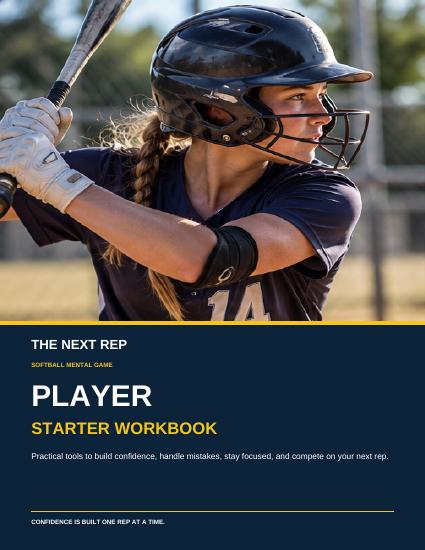
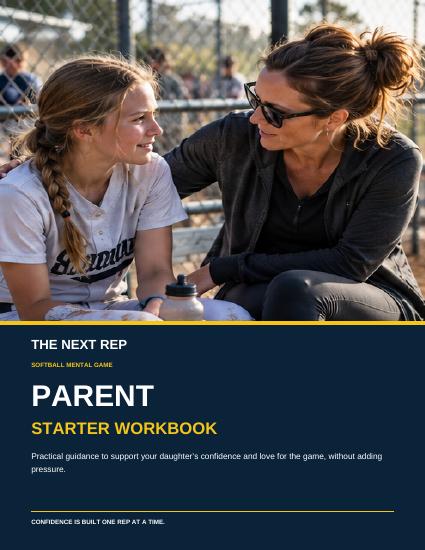
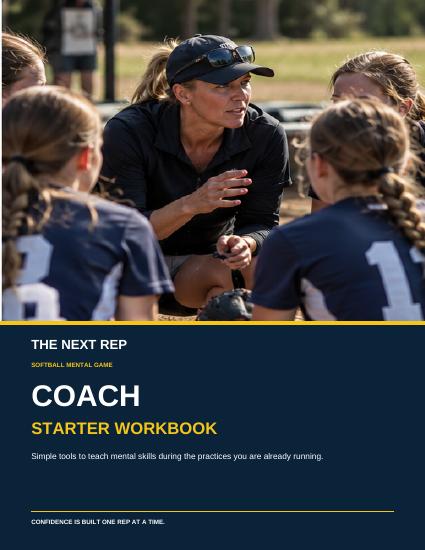
Get the free workbook made for you: player, parent, or coach.
The moments that decide games
Think about the moments that actually swing a game:
- The inning right after an error, when the next ball is coming
- Two strikes, runners on, the crowd loud
- A bad call in a close game
- The at-bat after a pitcher made you look silly
None of those are physical skills. Every player on the field can catch a routine ground ball. The question is whether she can catch it right after she booted the last one.
I know that moment personally. As a freshman, I earned the starting shortstop job in high school. I had the talent. But when I made an error, I couldn't shake it. One bobbled ground ball would follow me for the rest of the game. Nobody had ever taught me what to do next.
Why the gap exists
It isn't because coaches don't care. Most coaches I know care deeply about their players. The gap exists for three simple reasons:
- Coaches were never taught it themselves. Most of us learned the mental game by accident, if we learned it at all.
- It feels like it takes time away from practice. When you have 90 minutes and a long list of skills, "mental stuff" feels like a luxury.
- The resources out there are often expensive or built for elite athletes, not for the 12U travel team or the high school program with one coach and two volunteers.
So players are left to figure it out on their own. Some do. Most don't, or they figure it out years later, the way I did.
The mental game is a skill, and skills can be taught
Here's what changed everything for me. In college, I had coaches who treated the mental game like any other skill. We practiced what to do after a mistake, the same way we practiced hitting and fielding. My freshman year I hit under .300. After learning those tools, I hit .469, ranked #9 in the nation.
I wasn't a different athlete. I was a more confident, more consistent one.
That's the shift I want every coach to make: stop thinking of the mental game as a talk you give once a season, and start thinking of it as a skill you rep.
Three ways to start at your next practice
None of these add time to practice. They change how you practice.
- Teach a 5-second reset. After every rep in a drill, good or bad, players tap their glove, take one breath, and get back in ready position. The last play is over.
- Make adjustment part of the drill. After a miss in batting practice, ask, "What did you see? What will you change?" before the next swing.
- Measure what players control. Praise a hard line drive caught by the shortstop as loudly as a hit. Good at-bats lead to hits, not the other way around.
Why this matters beyond softball
The player who learns to let go of an error at 12 becomes the student who bounces back from a bad test at 16, and the adult who handles a setback at work. When we teach the mental game, we're not just building better softball players. We're building more resilient people.
That's why I built The Next Rep: simple, low-cost mental training any coach can start at the very next practice, in about 15 minutes, with word-for-word scripts so no one needs a sports psychology degree.
Every player deserves to learn these tools, and a lot earlier than I did.
Start here: try the free Team Mental Game Check to see where your team stands, or explore the 8-Week Coach Playbook.
Confidence is built one rep at a time.
Want this on paper? Get the free workbook.
These tools are educational and are not a substitute for mental health care.