
Angela Biddlestone
Founder of The Next Rep
Every coach has watched it happen. A routine ground ball goes under the shortstop's glove. A run scores. And then, before the next pitch, you can see it on her face: her head drops, her shoulders slump, and she's quietly hoping the ball doesn't come to her again.
Usually, it does. And one error turns into two, or three.
The error didn't cost the inning. The 5 seconds after the error did.
Get the free workbook
Free download: The Next Rep Workbook
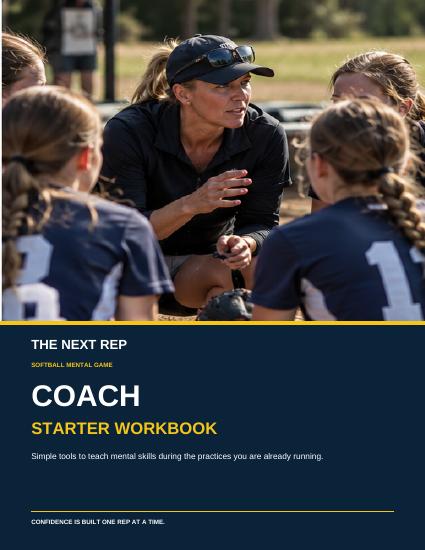
Get the free workbook made for you: player, parent, or coach.


Mistakes aren't the problem
Softball is a game of failure. A great college hitter might bat .400, which means she fails 6 out of 10 times. Pitchers walk batters. Catchers miss blocks. Every player on every team makes mistakes, every game.
The best players don't make fewer mistakes than everyone else. They just get ready for the next play faster.
That's the difference between a player who has a bad play and a player who has a bad inning.
Why players get stuck
When a young player makes a mistake, a lot happens at once. She feels embarrassed. She thinks everyone is watching. She replays the play in her head. And she's trying to do all of that while the next batter steps in.
Without a plan for that moment, most players do the only thing they know: they replay it. That's exactly what I did as a freshman shortstop. Nobody had ever taught me anything different.
Give them a routine
The fix is simpler than most coaches expect. Players need a short, physical routine they use after every mistake, something they've practiced so many times it happens automatically.
At The Next Rep, we call it RELEASE, RESET, ATTACK:
- RELEASE: a physical cue that says the play is over. Tap the glove, fix the helmet, wipe the hands.
- RESET: one slow breath and a short cue word, like "next ball" or "I want it."
- ATTACK: back in ready position, focused on the next job.
The whole thing takes about 5 seconds. The key is that it's the same every time, so it works even when emotions are high.
How to teach it
A reset routine only works if it's practiced. Talking about it once won't make it a habit. Here's how I'd install it with any team:
- Teach it in 5 minutes. Share a mistake story of your own first. When players hear their coach struggled too, they stop hiding their own mistakes.
- Rep it in every drill. In your normal ground-ball drill, every player runs her reset after every rep, good or bad. Skip it? One extra rep.
- Use it after great plays too. The last play is over either way. This keeps players from riding highs and lows.
- Give it a team cue. When a player makes a mistake in a game, a coach or teammate says, "What's your next rep?" That one question brings her back.
Within a couple of weeks, you'll start seeing players reset on their own. That's when you know it's working.
For parents
Parents can help, too. After a tough game, skip the play-by-play. Instead, ask: "Did you use your reset today? What happened on the next play?" It tells your daughter that how she responds matters more than the mistake itself.
The real goal
We will never coach mistakes out of the game. That was never the goal. The goal is to give players a way to handle them, so one bad play stays one bad play.
Start here: grab the free Game-Day Reset and other tools on our Resources page, or get full lesson plans in the 8-Week Coach Playbook.
Confidence is built one rep at a time.
Want this on paper? Get the free workbook.
These tools are educational and are not a substitute for mental health care.