
Angela Biddlestone
Founder of The Next Rep
One of the biggest misconceptions in softball recruiting is that the best player always gets the offer.
I wish it worked that simply.
I've spent years around this game as a college player, NCAA Division II head coach, and travel softball coach. And one thing I want players and parents to understand is that recruiting involves a lot more than batting averages, pitching velocity, and showcase performances.
Get the free workbook
Free download: The Next Rep Workbook
Get the free workbook made for you: player, parent, or coach.
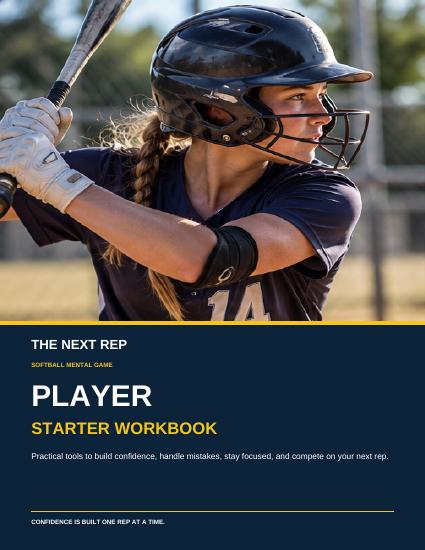
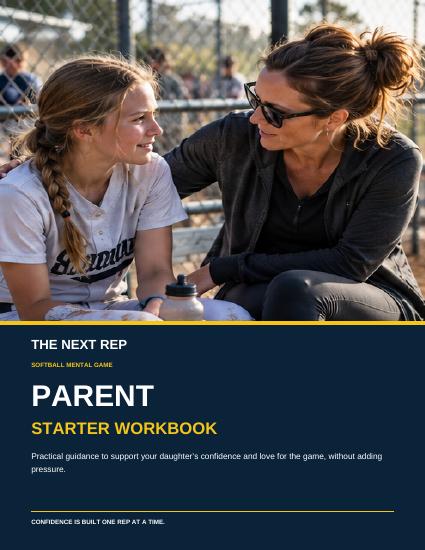
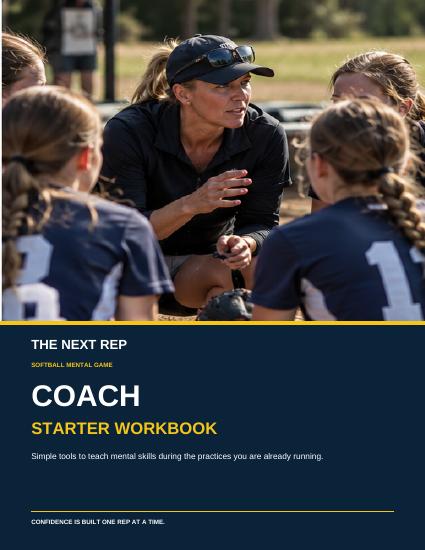
I've seen families get frustrated because one player receives an offer while another player, who they believe is just as talented or even better, doesn't.
And I understand why that can be confusing.
But here's what people outside the recruiting process don't always see.
College coaches aren't just evaluating how good a player is. They're evaluating how that player fits into the program they're trying to build.
Those are two very different things.
Let me explain what that means and what I'd encourage every family to understand before getting too far into the recruiting process.
1. Talent Gets You Noticed. Fit Helps Get You Recruited.
Let's start with the obvious.
Yes, you have to be able to play.
College coaches are evaluating athleticism, hitting ability, defensive skills, speed, arm strength, softball IQ, and your potential to compete at their level.
But they're also looking at something else.
Where do you fit on their roster?
A coach might already have three young shortstops.
They might desperately need a catcher.
They might be looking for a left-handed hitter, a power bat, a particular pitching style, or an athlete who can play multiple positions.
They may have limited recruiting spots or financial aid available for your graduating class.
So when a player doesn't receive an offer, it doesn't automatically mean she wasn't good enough.
Sometimes the program simply needs something different.
And that's something I wish more parents understood.
Recruiting isn't a ranking of every softball player in the country. It's a series of decisions about what each program needs.
2. Coaches Are Recruiting for the Future, Not Just Today
A college coach isn't only asking, "How good is this player right now?"
They're also asking:
"How good can she become?"
A player might not be the most polished athlete on the field, but she may have tremendous athleticism, good fundamentals, and the ability to make adjustments.
Another player might be dominating at 15 because she's physically more developed than her competition.
That doesn't automatically mean she'll have the same advantage at 19.
Coaches are trying to project how a player will develop over the next several years.
They look at movement, coordination, athleticism, skill foundation, and how much room they believe the athlete has to grow.
This is one reason I tell parents not to get caught up in comparing their daughter to every other player.
Development isn't linear, and recruiting decisions aren't always based on who's having the best season right now.
3. How You Handle Failure Matters
Here's something I paid attention to as a coach.
What happens after a player makes a mistake?
Does she recover and get ready for the next play?
Does she remain engaged with her teammates?
Can she make an adjustment?
Or does one bad at-bat affect the rest of her game?
I'm not suggesting college coaches expect teenagers to be emotionally perfect.
They don't.
Players get frustrated. They have bad games. They make mistakes.
What matters is how they're learning to respond.
If I were evaluating a player, I'd want to see how she competes when things aren't going her way.
Because at the college level, adversity is guaranteed.
You're going to face better pitching.
You're going to compete for playing time.
You're going to have difficult practices and disappointing performances.
Coaches want athletes who can learn, adapt, and continue competing.
That's one reason mental training matters long before a player reaches college.
4. Coachability Is More Than Saying "Yes, Coach"
I think coachability is one of the most misunderstood qualities in youth sports.
Being coachable doesn't mean agreeing with everything or never asking questions.
To me, coachability means being willing to learn.
Can the player listen to feedback?
Can she understand what the coach is asking?
Can she make an adjustment?
Does she take responsibility for her development?
At a camp, I wouldn't just pay attention to the player who executed every drill perfectly.
I'd also notice the player who struggled with something, listened to instruction, and improved on the next rep.
That tells me something about her potential.
College coaches don't expect finished products. They want athletes they can continue developing.
5. Coaches Are Watching More Than the Player With the Ball
Parents sometimes assume that college coaches only pay attention when their daughter is hitting, pitching, or making a defensive play.
But there's a lot to learn between those moments.
How does she prepare?
Does she understand the game situation?
Is she communicating?
Does she support her teammates?
How does she respond when she's not playing?
Does she remain engaged?
None of these things replaces athletic ability.
But they can help a coach understand what kind of teammate and competitor they're evaluating.
And here's something important.
You don't have to be the loudest player on the field to demonstrate leadership.
Some players lead through communication. Others lead through preparation, consistency, and how they treat teammates.
Be yourself, but understand that your behavior is part of what coaches are evaluating.
6. Team Culture Is a Real Recruiting Consideration
Imagine you're a college coach.
You're bringing athletes together from different states, backgrounds, coaching experiences, and personalities.
They're going to practice together, travel together, compete for positions, handle setbacks, and spend a tremendous amount of time together.
Wouldn't you want to know whether a prospective player will contribute positively to that environment?
That's why coaches ask questions beyond softball.
They want to understand the athlete's goals, values, work ethic, and expectations.
They may speak with travel coaches or high school coaches.
They may pay attention to how the athlete interacts with teammates and family members.
And yes, parents, how you conduct yourselves can become part of that picture.
That doesn't mean families need to be silent or afraid to ask questions.
It means respectful communication and healthy boundaries matter.
College coaches aren't just building a lineup. They're building a team.
7. Academics Can Open or Close Doors
I can't emphasize this enough.
Don't overlook academics because your daughter is talented.
Different schools have different admissions standards, academic expectations, and financial aid opportunities.
A player might be a great athletic fit but not meet a school's academic requirements.
Strong academics can also expand the number of schools a player can realistically consider.
And for families, academic and institutional financial aid may be an important part of making college affordable.
My advice?
Take school seriously from the beginning.
Not just because it helps with recruiting.
Because softball eventually ends, and the education matters.
8. Bigger Programs Aren't Automatically Better Fits
This is another area where I think families get caught up in comparisons.
Division I gets a tremendous amount of attention.
And there's nothing wrong with wanting to compete at that level.
But Division II, Division III, NAIA, and junior college programs can also provide excellent athletic and academic experiences.
The question shouldn't simply be:
"What's the highest division my daughter can play?"
I'd encourage families to ask:
"Where can she develop, contribute, receive a good education, and have the college experience she wants?"
Look at the coaching staff.
Look at the academic programs.
Look at the roster.
Look at the school's location and cost.
Ask about the team's expectations and culture.
And be realistic about the role your daughter might have.
The right school isn't necessarily the one with the biggest name. It's the one that's the right fit for the athlete.
9. Players Need to Take Ownership of Their Recruiting Process
Parents, I know you want to help.
And you should.
The recruiting process can be overwhelming, especially when families are trying to navigate camps, showcases, emails, videos, and recruiting rules.
But college coaches are recruiting your daughter.
Not you.
They want to get to know her.
What does she want to study?
Why is she interested in their school?
What are her goals?
How does she communicate?
Can she ask thoughtful questions?
As players get older, they should increasingly take ownership of those conversations.
Parents can help organize information, research schools, and provide guidance.
But let your daughter develop the confidence to communicate for herself.
That's a skill she'll need in college anyway.
What Should a Recruiting Email Include?
Keep it simple and personal.
Include your name, graduation year, position, travel team, academic information, and a link to a short skills video.
Explain why you're interested in that particular school.
Include your upcoming tournament schedule when relevant.
And make sure the email actually sounds like you.
College coaches receive a lot of recruiting communication.
A thoughtful, specific email is more useful than a generic message sent to hundreds of schools.
10. Recruiting Is a Two-Way Evaluation
This might be the most important thing I want families to remember.
The college coach is evaluating your daughter, but your daughter should be evaluating the college coach and program, too.
Ask questions.
How does the coach develop players?
What does the program value?
How does the coaching staff handle mistakes?
What are the expectations around academics?
How does the team communicate?
What does the roster look like at your position?
What opportunities might exist for development and playing time?
And pay attention to how the staff treats players.
Not just the starters.
Everyone.
You are making a decision about where your daughter may spend four important years of her life.
Don't make that decision based only on a uniform, a social media announcement, or the excitement of receiving an offer.
What Have Some of the Best College Coaches Said About Recruiting?
I wanted to include a few perspectives from successful college coaches because these aren't just things I've observed. They're considerations other coaches have publicly discussed as well.
Carol Hutchins — Former University of Michigan Head Coach
Hutchins has emphasized the importance of a player's values and whether she understands being part of something bigger than herself.
Her recruiting perspective reinforces that a talented athlete also needs to understand how she contributes to a team.
My takeaway: Talent matters, but so does the willingness to be part of something beyond your individual statistics.
Source: Little League / ONE Softball, What Sets Great Athletes Apart in Recruiting?
Rhonda Revelle — University of Nebraska
Revelle has discussed how much work goes into evaluating recruits and how outsiders often don't know the individual circumstances behind roster decisions.
She has identified athletic tools, game knowledge, attitude, teammate interactions, character, and coachability as recruiting considerations.
My takeaway: Parents may see two athletes and wonder why one received an offer. The recruiting staff may be considering information that isn't visible from the stands.
Source: Extra Inning Softball, College Coach Corner, December 2021.
Kristi Bredbenner — Wichita State
In the same interview series, Bredbenner emphasized athleticism, demeanor, character, competitiveness, and a willingness to improve.
She also discussed the importance of athletes fitting the team's culture.
My takeaway: A coach isn't simply asking whether a player can help win games. They're also asking whether that player is someone they want to develop and build a team around.
Source: Extra Inning Softball, College Coach Corner, December 2021.
A Note About Showcases and Recruiting Camps
I know families spend a lot of money trying to get their daughters exposure.
Travel expenses, showcase fees, camps, recruiting services—it adds up quickly.
And I don't think every opportunity is worth the investment.
Before signing up for an event, ask:
Are schools on my daughter's realistic target list attending?
Does the event give coaches a meaningful opportunity to evaluate her?
Is she at the right stage of development?
Has she contacted the programs she's interested in?
Would this money be better spent on development or visiting a school that's already showing interest?
A showcase can be valuable.
A college camp can be valuable.
But neither guarantees recruitment.
Exposure matters, but it needs to be intentional.
What About Recruiting Timelines?
Recruiting rules vary by division and can change.
As of the 2026–27 recruiting cycle, NCAA Division I softball coaches generally cannot initiate recruiting communication with prospective athletes before September 1 of their junior year of high school.
Other divisions have different rules, so families should verify the current requirements directly with the NCAA and individual programs.
Don't assume that a lack of response from a college coach means a lack of interest. Sometimes communication restrictions apply.
And don't assume every player needs to be committed at the same age.
There are different paths to playing college softball.
My Final Advice to Players and Parents
If I could leave families with one message from my experience as a former college head coach, it would be this:
Stop trying to make your daughter the perfect recruit for every school. Help her become the best player, teammate, and person she can be—and find the program that values what she brings.
Keep developing her physical skills.
Teach her how to respond to mistakes.
Help her become independent and accountable.
Encourage her to communicate and ask questions.
Take academics seriously.
And remember that one coach's decision doesn't determine her worth or her future in softball.
Not every program will be the right fit.
And that's okay.
The goal isn't to get recruited by everyone.
The goal is to find the right place to continue growing, competing, and enjoying the game.
Because at the end of the day, we're not just developing softball players.
We're developing young people who will carry these lessons long after their playing careers are over.
Confidence Is Built One Rep at a Time.
About The Next Rep
The Next Rep helps softball players, parents, and coaches develop the mental skills that support confidence, accountability, leadership, and performance.
Explore our free resources:
By a former NCAA Division II head softball coach and college softball player.
Want this on paper? Get the free workbook.
These tools are educational and are not a substitute for mental health care.