
Angela Biddlestone
Founder of The Next Rep
Years ago, I worked at a batting cage in Maryland. Professional and minor league players came through those doors, and I watched everything: how they prepared, how they talked about hitting, how they handled a bad round.
That's also where a Hall of Fame MLB scout became my mentor. He'd spent decades inside Major League organizations, and he gave me an inside look at how pro hitters were trained.
One lesson changed how I hit, and how I've coached ever since:
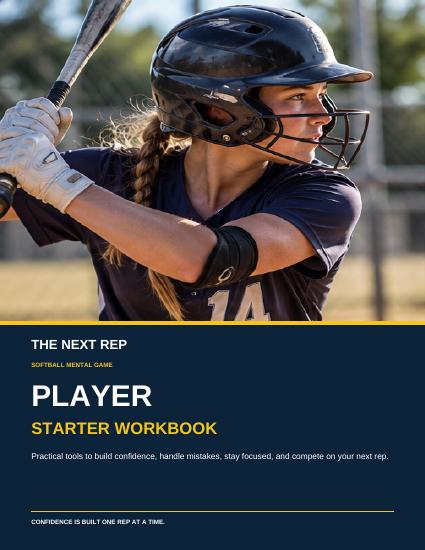
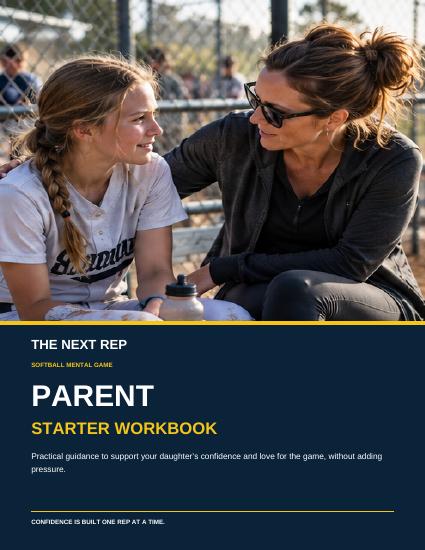
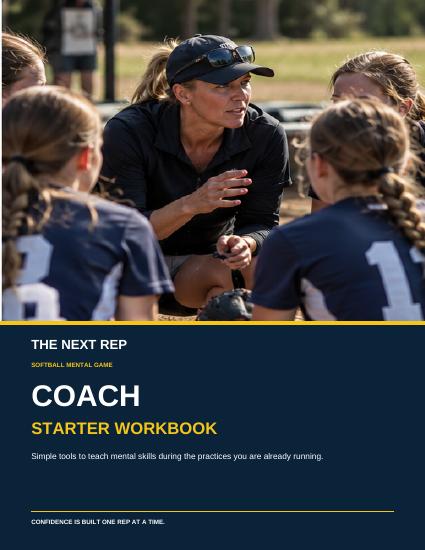
Get the free workbook
Free download: The Next Rep Workbook
Get the free workbook made for you: player, parent, or coach.
A hitter's job isn't to get a hit. It's to put a good swing on a good pitch.
Why hits are a bad scoreboard
Think about a hitter who lines out to the shortstop twice and walks once. The box score says 0 for 2. She walks to the car feeling like she failed.
Now think about a hitter who chases a pitch at her eyes and bloops it over the second baseman's head. The box score says 1 for 1. She feels great.
Which at-bats would you rather your hitter repeat?
When players judge themselves only by hits, they judge themselves by something they don't fully control. A hard line drive can be caught. A weak swing can fall in. That's how one bad game turns into a two-week slump: the hitter keeps chasing results, and starts swinging at worse and worse pitches to get them.
What a quality at-bat looks like
A quality at-bat measures what the hitter controls. It can include:
- Hard contact, out or not
- Seeing 6 or more pitches
- A walk, especially after falling behind
- Moving a runner over, or scoring a runner from third
- Fouling off tough two-strike pitches to stay alive
Hitters who stack quality at-bats get the hits eventually. The numbers take care of themselves.
What it did for me
I took that lesson into my own career. I stopped chasing. I made pitchers give me pitches I could drive, and I didn't help them out. My on-base percentage climbed, and I went from hitting under .300 my freshman year of college to .469, ranked #9 in the nation.
I wasn't swinging harder. I was swinging smarter, at better pitches.
How to bring it to your team
- Score BP on quality, not hits. Give points for a swing at a strike, a good take, hard contact, and a visible reset after the at-bat. Announce the top scores, especially hitters who scored high without many hits.
- Change the post-game question. Instead of "Who got hits?" ask "Who had a great at-bat that didn't end in a hit?"
- Post a quality at-bat leaderboard instead of batting averages. Players chase what you measure.
A note for parents
On the ride home, try swapping "How'd you hit?" for "How many quality at-bats did you have today?" One question is about results. The other is about effort and decisions, and that's where confidence grows.
The bigger lesson
The best hitters I've watched, from the batting cage to college to the pros, all shared this: they didn't let one at-bat define them. They measured the process, trusted it, and got ready for the next pitch.
That's a lesson that works far beyond the batter's box.
Go deeper: the Pro Hitting Approach Playbook has seven lessons on how pro hitters think, with coach drills and parent questions in every one.
Confidence is built one rep at a time.
Want this on paper? Get the free workbook.
These tools are educational and are not a substitute for mental health care.